
AI adoption is rising fast - but ROI is not evenly distributed
Published:
Updated July 2026: added the operating-impact map and the US/China/Europe capital, deployment, and policy comparison from the full carousel below.
AI adoption is rising quickly
But adoption alone is a weak proxy for economic value. The more relevant question is whether AI changes measurable operating performance - not whether a team has a tool in hand, but whether that tool moves a number that matters.
This short research note pulls together evidence from the Stanford AI Index, McKinsey, NBER / Quarterly Journal of Economics, the Economic Journal, the IFR World Robotics report, and the European Commission. The pattern across all of them is consistent.
The note, as a carousel
A six-slide visual version of this note - the same one shared on LinkedIn:
Swipe or scroll sideways through all six slides
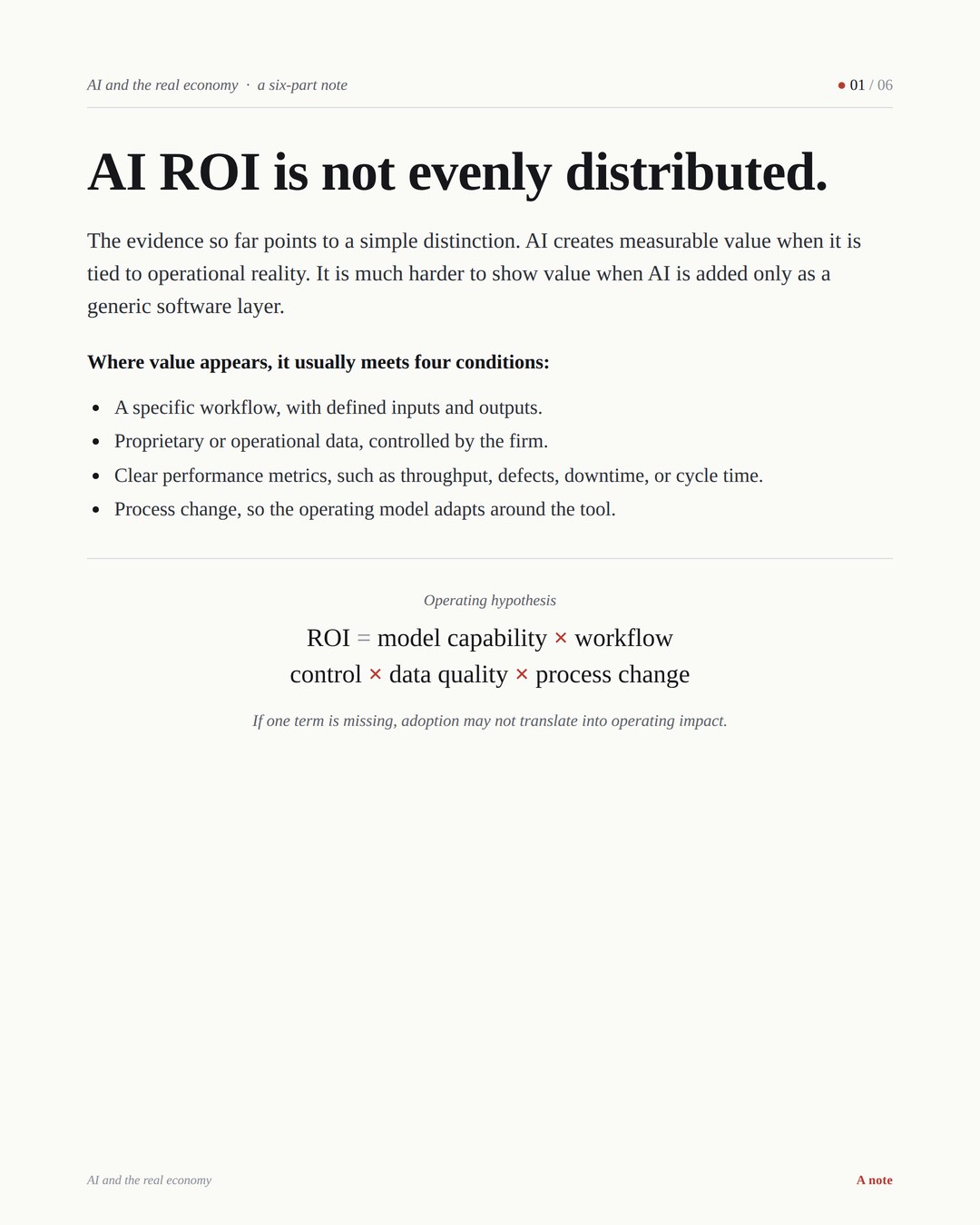
AI ROI is not evenly distributed
The strongest, most defensible cases for return on AI show up under a specific set of conditions. AI delivers measurable value when it is embedded into operational reality, not bolted on as a feature:
- A bounded workflow - a defined task with clear inputs and outputs, not an open-ended “assistant.”
- Firm-specific data - proprietary context the model cannot get anywhere else.
- Measurable outputs - cost, throughput, quality, or cycle time that can be tracked before and after.
- Process change around the tool - the operating procedure is rebuilt around the AI, not just supplemented by it.
Where these four conditions hold, the productivity and quality gains in the literature are real and repeatable. Where they don’t, “AI adoption” tends to stay a line item rather than a performance driver.
Where the evidence is strongest
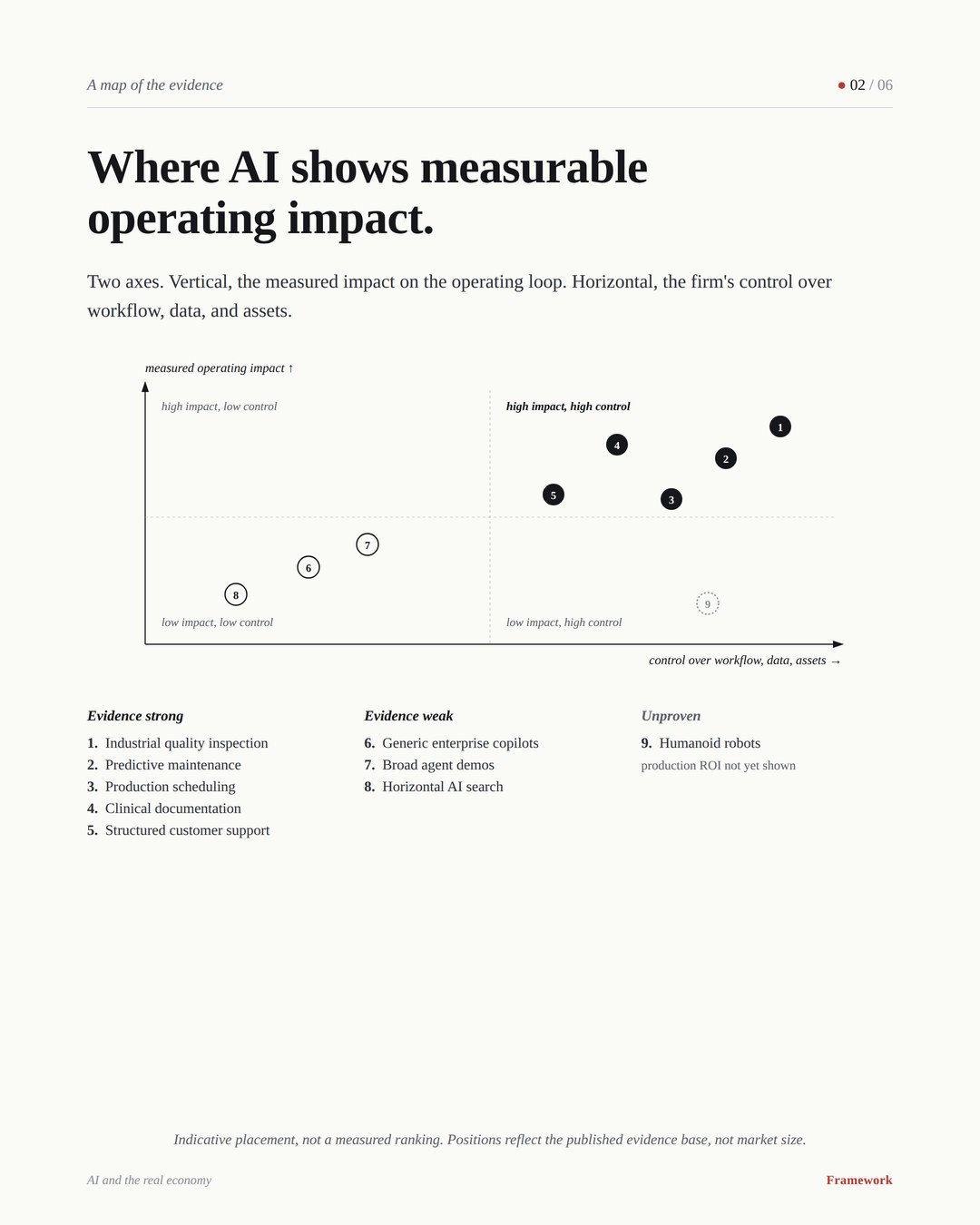
A useful way to read the evidence is through two questions: does AI change a measurable operating loop, and does the firm control the workflow, data, or assets around that loop? The strongest cases sit where both are true - industrial quality inspection, predictive maintenance, production scheduling, clinical documentation, and structured customer support. The weaker cases - broad agent demos, generic enterprise copilots, horizontal AI search, macro forecasts - tend to cluster where impact isn’t yet measured, control isn’t held, or both.
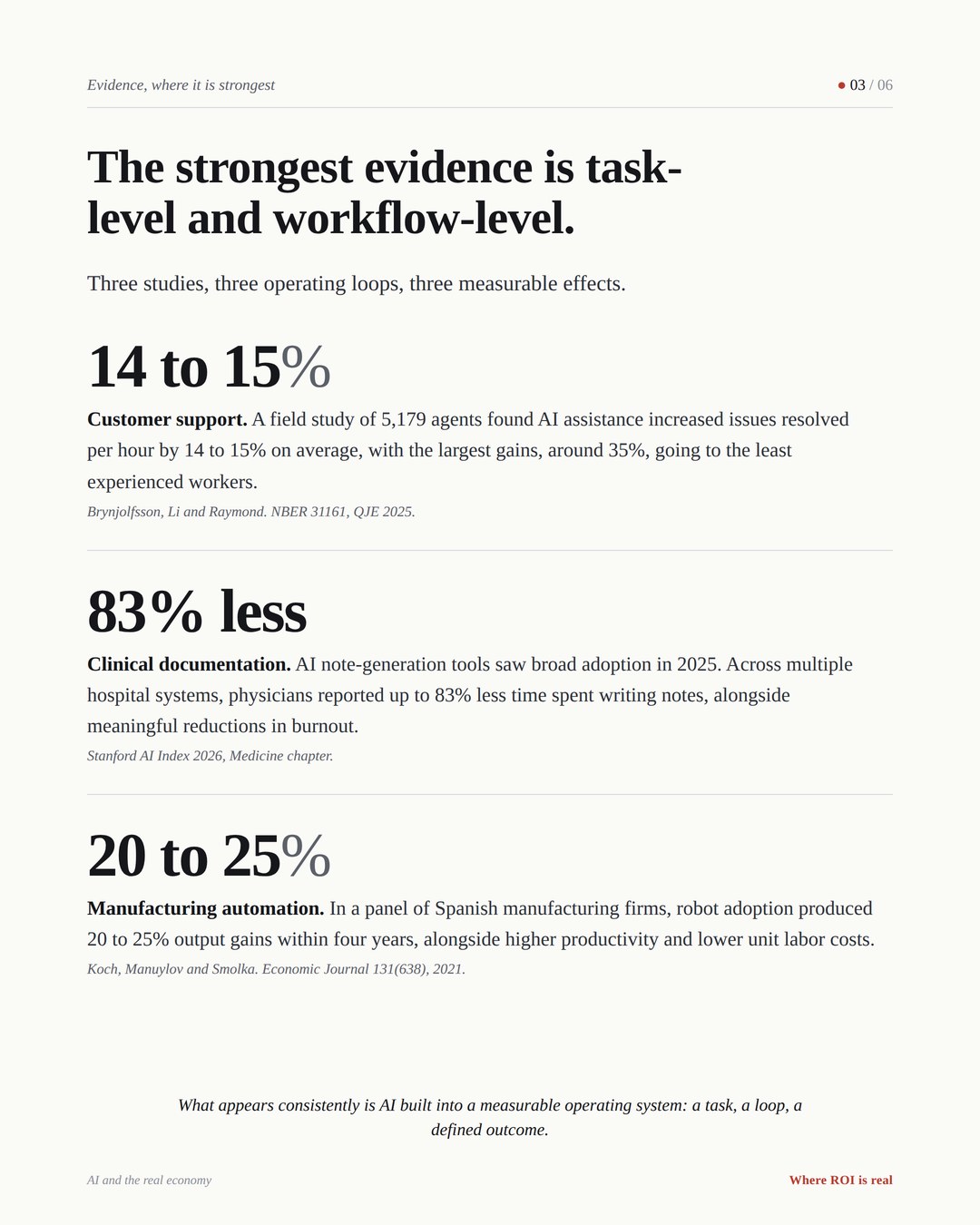
The clearest productivity gains don’t come from “AI in general.” They show up in bounded settings where the task repeats, the output is observable, and performance can be compared before and after deployment:
- 14 to 15% average productivity gain in customer support: a field study of 5,179 agents found AI assistance increased issues resolved per hour by 14-15% on average, with the largest gains among less-experienced, lower-skilled workers (Brynjolfsson, Li & Raymond - NBER / QJE).
- Up to 83% reported reduction in documentation time for clinical documentation: AI note-generation tools show value not because the text is better, but because a painful, repeated workflow gets less time and clinicians get more capacity back (Stanford AI Index - Medicine chapter).
- 20 to 25% output gain over a four-year horizon from manufacturing automation: robot adoption shows value once automation changes the production system itself, measured at firm level rather than task level (Koch, Manuylov & Smolka - Economic Journal).
The common pattern isn’t “AI in general.” It’s AI embedded into a measurable operating system - a task, a loop, and a defined outcome.
Where adoption outruns ROI
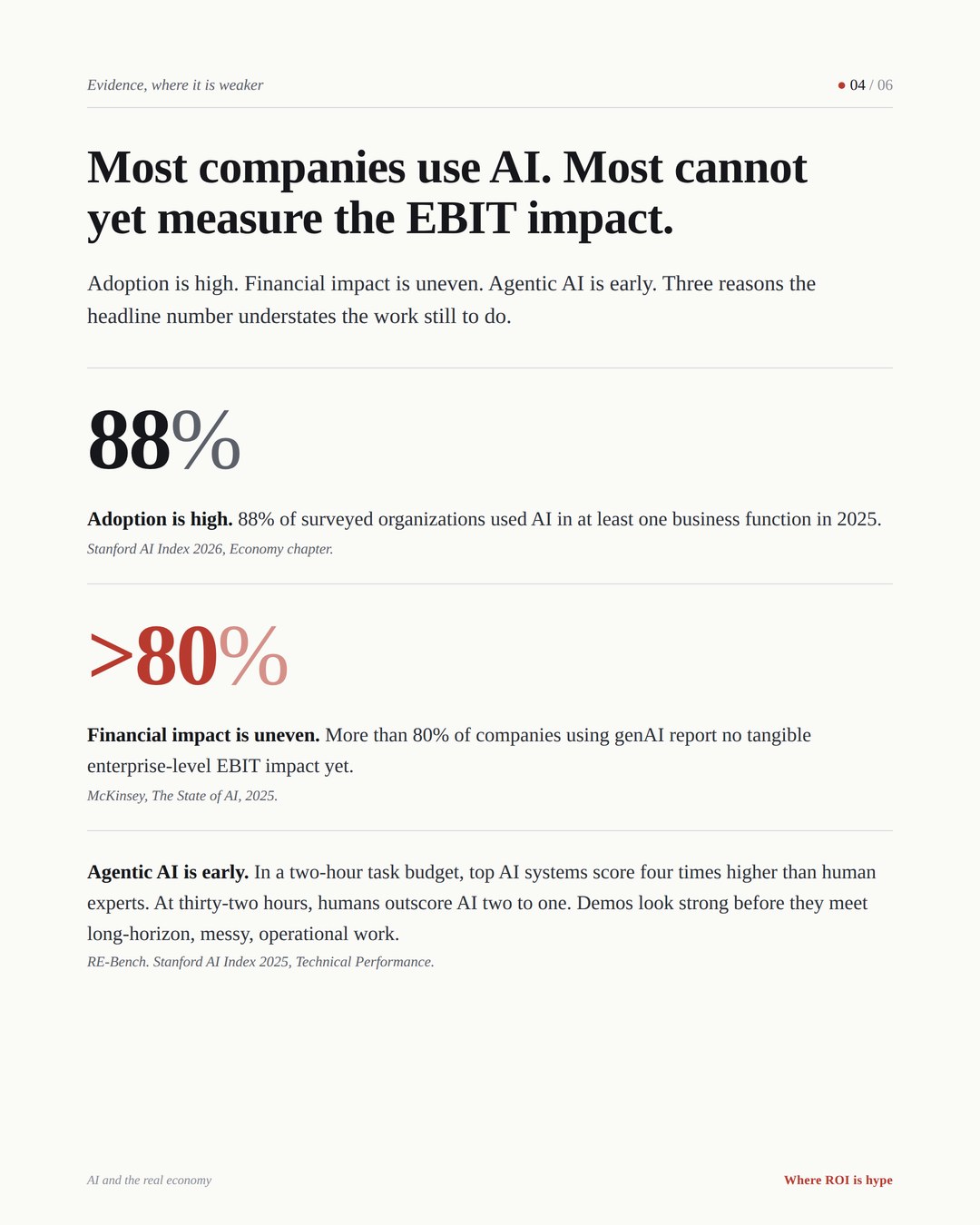
Adoption numbers show AI has entered the enterprise. They don’t yet show it has changed enterprise economics.
- 88% of surveyed organizations used AI in at least one business function in 2025 (Stanford AI Index 2026 - Economy).
- Over 80% of companies using generative AI report no tangible enterprise-level EBIT impact so far (McKinsey - The State of AI, 2025).
- On long-horizon agentic tasks, the gap between benchmark and business outcome shows up directly: on a 2-hour task budget, top AI systems scored about 4x higher than human experts; on a 32-hour task budget, human experts outscored AI about 2:1 (RE-Bench, Stanford AI Index 2025 - Technical Performance).
Short demos can look extremely strong. Performance often changes once the task gets longer, messier, and closer to real operational work with real accountability - which is exactly the gap between a benchmark result and a business outcome.
Why this matters for venture capital
This distinction is where a lot of AI investing gets decided.
Many AI companies can show product usage. Far fewer can show that their product changes a production loop - that it reduces cost, increases throughput, improves quality, or shortens a measurable process. Usage tells you people opened the tool. A changed production loop tells you the business runs differently because of it.
That gap is the whole game. The key diligence question is not:
“Does this company use AI?”
It is:
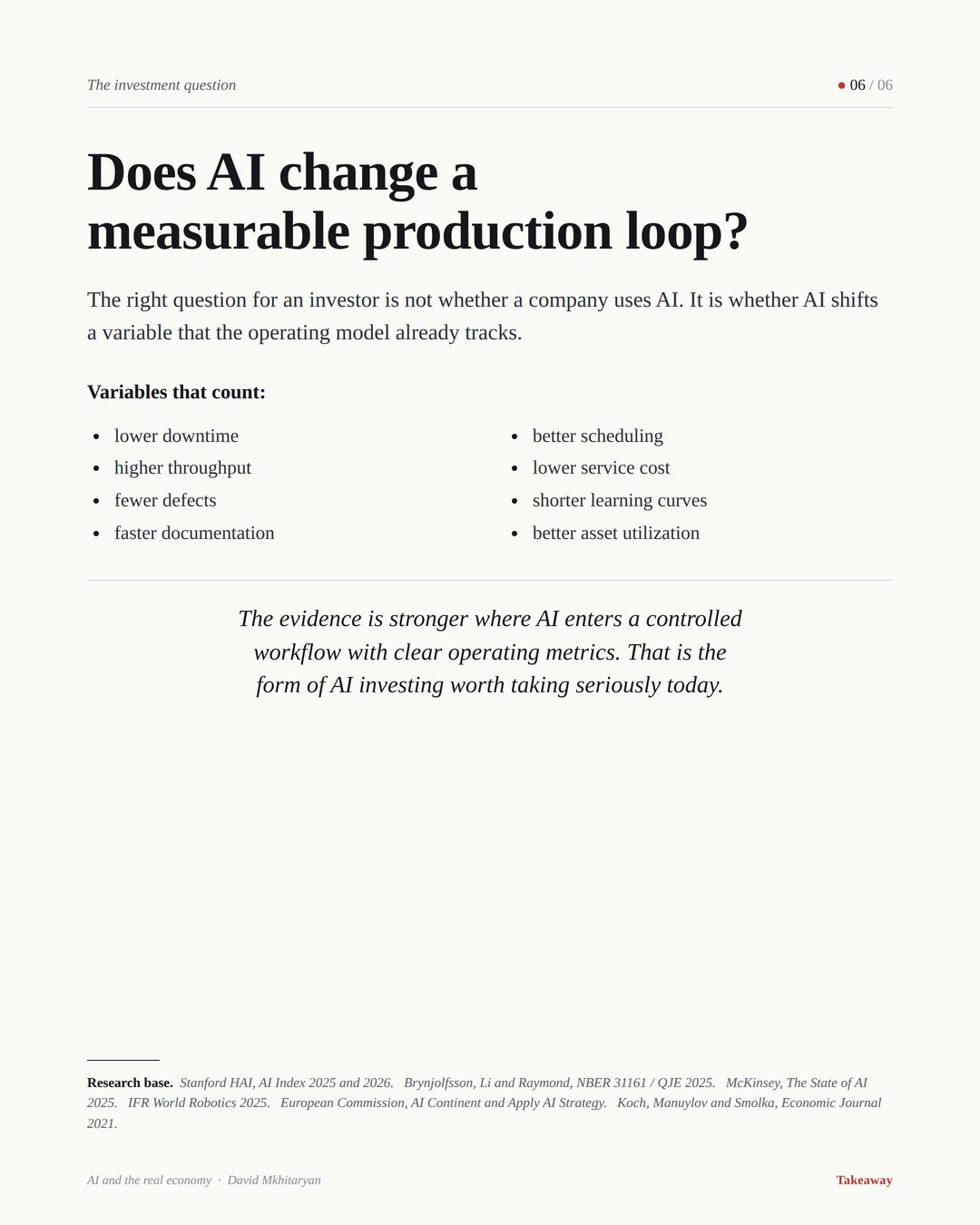
“Does AI change a measurable production loop?”
That is the line where AI stops being a software feature and becomes economic infrastructure - and it’s where durable margins, defensibility, and pricing power tend to come from.
When evaluating AI companies, what comes first?
The same four conditions map onto what I look at first in an AI company:
- Model quality - necessary, rarely sufficient, and increasingly commoditized.
- Workflow control - does the product own a bounded, repeatable process?
- Proprietary data - is there a data position competitors can’t replicate?
- Measurable ROI - can the customer point to a number that moved?
My weighting leans toward the last three. Model quality is the price of entry; workflow control, proprietary data, and measurable ROI are what compound.
I’d be interested to hear how investors, founders, and operators think about this distinction. When you evaluate AI companies, what do you look at first?
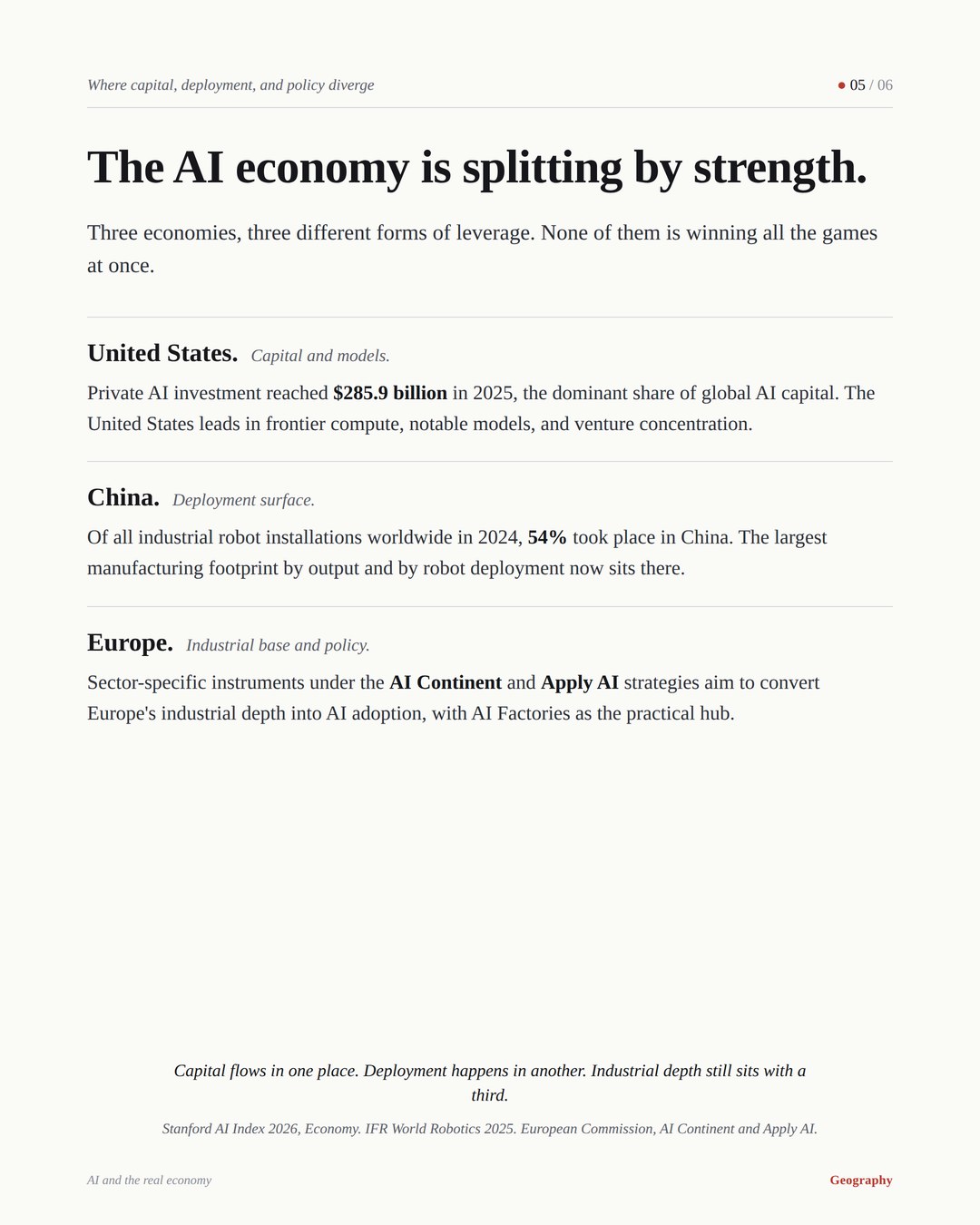
Where capital, deployment, and policy diverge
The global AI race isn’t one race - different regions are building different advantages, and that shapes where AI ROI is likely to show up first.
- United States - capital & models: $285.9B in private AI investment in 2025, heavily concentrated and reinforcing US leadership in notable model production, compute access, and venture-backed AI companies (Stanford AI Index 2026 - Economy).
- China - deployment surface: a 54% share reflecting an advantage that isn’t only about model development - China has a large industrial base where automation can be deployed, tested, and scaled across real production environments (IFR World Robotics 2025).
- Europe - industrial base & policy: 19 AI Factories being built across 16 Member States to give startups, SMEs, and industry access to AI-optimised supercomputing, technical support, and applied AI infrastructure (European Commission - AI Factories, AI Continent & Apply AI Strategy).
For comparison, private AI investment in 2025 ran roughly $285.9B in the US against $12.4B in China - the US advantage is capital concentration, China’s is deployment surface, and Europe’s opportunity is converting industrial depth and public infrastructure into measurable AI adoption. For AI ROI specifically, the key question is which region connects models to measurable operating loops fastest - which is the same question this whole note has been asking at the company level, just applied at the level of an economy.
The variables that count
Across company and country level, the same short list of variables is what separates AI adoption from AI ROI: lower downtime, higher throughput, fewer defects, faster documentation, better scheduling, lower service cost, shorter learning curves, reduced rework. Where AI enters a controlled workflow with clear operating metrics on variables like these, the evidence is stronger - and that’s the form of AI adoption worth taking seriously: less visible than demos, harder to fake, and more closely tied to real economic value.
Full research note
A formatted version of this note, with the underlying evidence, is available as a PDF:
Sources
- Stanford HAI, AI Index Report 2026, Economy chapter — PDF
- Stanford HAI, AI Index Report 2026, Medicine chapter — link
- Stanford HAI, AI Index Report 2025, Technical Performance chapter — link
- Brynjolfsson, Li & Raymond, “Generative AI at Work,” NBER Working Paper 31161 — link
- Brynjolfsson, Li & Raymond, “Generative AI at Work,” Quarterly Journal of Economics, 2025 — DOI
- McKinsey, “The State of AI: How organizations are rewiring to capture value,” 2025 — link
- Koch, Manuylov & Smolka, “Robots and Firms,” The Economic Journal — DOI
- International Federation of Robotics, World Robotics 2025 / China robotics strategy — link
- European Commission, AI Continent Action Plan — link
#AI #VentureCapital #AIAdoption #DueDiligence #Productivity #Robotics
Original LinkedIn post: AI ROI - what can be measured (with the full carousel and discussion)
About the Author: David Mkhitaryan is a Venture Capital Analyst at Innovis VC specializing in AI/ML startup evaluation and technical due diligence, with an engineering background and a focus on the Berlin startup ecosystem.